
PubTech Radar Scan: Issue 43
Usual mix of academic publishing tech news, launches, interesting stats, AI developments, and longer reads that caught my attention.
📰 News:
PLOS’s Redefining Publishing: Practical pathways to open science is long but interesting. “Our transition to Janeway for submissions is one example of this approach. Rather than acting as a passive user of a platform, we are investing engineering effort upstream, contributing code and ideas, and helping to shape the direction of the project alongside a wider community.” I don’t think this is a surprising move, given the arguments in the report or the options available, but I doubt anyone would have considered PLOS using Janeway a serious possibility 10 years ago.
“Google announced this week that publishers can now remove their content from AI Overviews while staying indexed in regular search. Publishers had demanded this for years. It finally arrived, delivered under pressure from the UK’s Competition and Markets Authority. The toggle went live June 3. And yet it doesn’t feel like relief. Because opting out of AI Overviews means opting out of the surface where search is going. And opting in is the status quo. Content feeds the answers, traffic doesn’t come back. Neither option is a deal.” Using Ezra Eeman’s words here as they sum up the situation nicely.
The Company of Biologists has published results from its Fast & Fair paid peer review trial. Average time to first decision fell from 37.7 working days to 5.5, invitation acceptance jumped from 23% to 67%, and handling editors found no drop in review quality (Reviewers receive £220 per manuscript). This is a tech-focused newsletter, but including it because human solutions are often easier/faster. [Preprint | Summary in Research Information]
🚀 Start-ups:
The Dutch Groep Algemene Uitgevers (General Publishers Group) has announced its “Renew the Book 2026” award longlist - seven projects covering everything from AI literary companions to inclusive picture books and cinematic book trailers. Among them is BookStories (openscience.works), which builds open, reusable services to help researchers, libraries, and publishers understand how open scholarly works are being used, shared, and discussed using transparent metrics.
📈 Stats:
The ScholarOne Future of Peer Review 2026 report is out. I’m one of the interviewees, which gives me a vested interest in flagging it, but it does contain some interesting data. For example, reviewer invitations sent by journals via ScholarOne rose from 9M in 2018 to nearly 21.5M in 2025 (some caveats around that stat in the report). Despite working in academic publishing for years and understanding the scale, I still find the size of numbers like this staggering.
In the first 16 days of April, automated bots generated 5.7 billion hits across BMJ sites, compared with an expected 19.7 million hits in a typical 16-day period (289 times the normal level of traffic). [Ian Mulvany’s Keynote from Force 2026]
From Springer Nature’s Q1 update: “Our article publication growth of 15% continued to outpace the market, which we estimate grew around 6%.” This is a simplistic analysis, but a 15% growth in output with a 1.7% increase in the implied Research cost base, probably 6-7% once exchange rates are taken into account, and rising profit margins are [quite impressive or troubling, depending on whether you see this as a business scaling well or as more value being extracted from the research community].
Anthropic research surveyed 1,260 quantitative social scientists on AI use, and the headline found 81% have tried AI chatbots, but only 20% use coding agents like Claude Code that actually write and run analysis autonomously. I think 20% is a high level of usage for a tech that’s really only a year old.
Ali Ghodsi, Co-Founder & CEO at Databricks: Three years ago, queries coming to Databricks were 100% human. A month and a half ago, it crossed the tipping point past 50%. Today? Over 81% of database queries are executed by autonomous agents, not humans.
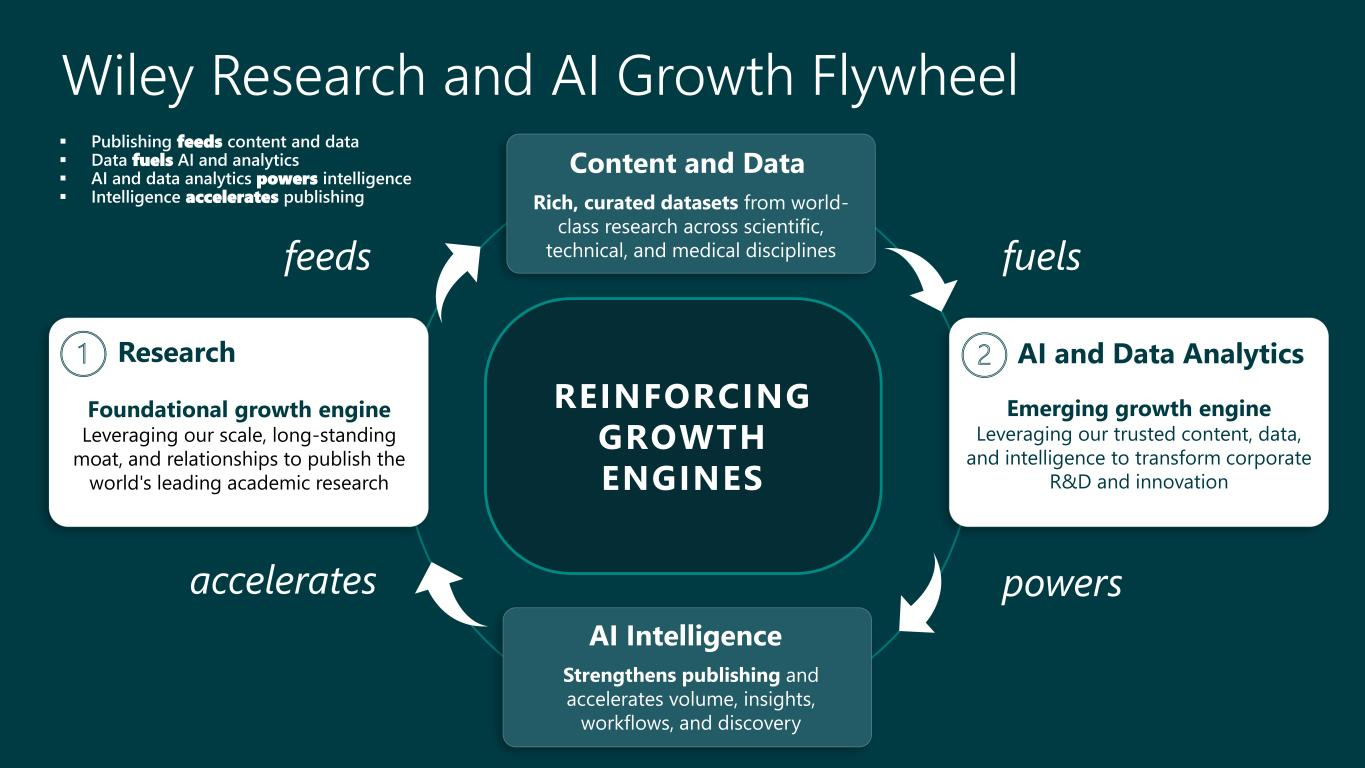
Wiley has acquired Emerald and says it expects about $30m of annual run-rate cost synergies. To put that in context, and if my maths is right, they are expecting annual run-rate cost savings equivalent to roughly $86k per Emerald employee. Emerald has 350 employees and projected FY26 revenue of $85m. $30m divided by 350 employees is $85,714, or about $86k per employee. Wiley is pitching Emerald as part of a larger AI growth model in which trusted research content becomes fuel for data analytics and AI intelligence.
🤖 AI:
Ian Mulvany and co have written up how the BMJ and AWS Generative AI Innovation Center developed an AI-powered editorial assistant designed to help journal editors screen submitted research manuscripts to make better decisions about which papers to send for further peer review, which to reject, and why.
Christina Spencer on building AI interfaces at JSTOR
The Economist is preparing for “a world with two versions of the web” — one optimized for rich, human reading experiences, and another where “agents want clear structure, questions and answers, ideally text,” [Digiday]. This kind of thinking also comes through in Tony Alves’s excellent write-up of the PurePub.ai conference. On the one hand, creating structured content for agents seems obvious to me; on the other hand, we’ve been having this conversation since the semantic web was first mooted. Maybe it will happen this time, or maybe world models will come along, and academic publishers can remain focused on PDF-like containers?
Mark Riley is thinking along similar lines with news: “For 25 years, most digital news has still been shaped around the article as the atomic unit: headline, image, intro, body copy, related links, comments if you are feeling brave. But the AI interface invites a different behaviour. “Explain this to me.” “What’s the background?” “Why does it matter?” “Who benefits?” That is not search. It is not social. It is not even really aggregation. It is news as an explainer engine”
The Hand That Feeds: Publishing’s AI Hypocrisy Problem by Mark Williams. “Publishers have constructed, with meticulous care, a moral circle around creative labour. Inside the circle: authors, illustrators, narrators, translators - the human artists whose displacement by AI is framed as an existential crisis, a theft, an assault on imagination itself. Outside the circle: engineers, warehouse operatives, phone operators, metadata specialists, marketing copywriters, junior editorial assistants - the human workers whose displacement by the same AI is framed as efficiency, innovation, or simply not mentioned at all.”
Simon Linacre from Cabells on The end of the papermill? “One consequence of this increased use of AI to produce articles is that usage of paper mills may actually decline. The reasoning is that, assuming some authors follow a path of least resistance in their publishing strategy, they will see that the benefits of paper mills (ready-made articles, supplied for a price) are less than the benefits of using AI to write something for them (ready-made articles, supplied for free).”
Thibault Geoui on A system of trust for science: rethinking validation (/review) in scientific publishing (Via Chris’s must-read Scalene newsletter)
I agree with much of what Todd Toler says in his Scholarly Kitchen interview, particularly the comments about proprietary solutions leading to fragmentation and silos. I don’t entirely agree with this: “AI agents struggle to access PDFs and extract information from figures and tables”. I think the latest models are getting good at this, but they aren’t perfect yet.
A Snapshot of GenAI Tools for Research | HKUST Library is a really good summary, highlighted by Aaron Tay in AI academic search needs better frameworks for understanding and evaluation. These three librarian projects are a start
🌎 Ithaka S+R has produced a LibGuide focused on the Environmental Impacts of AI
📅 Events:
Cambridge AI meetup, 25 June (webinar): AI Hallucination - why it matters and what can be done. Speakers: Damien Charlotin on his database of legal hallucinations, Richard Sloggett (Referonix) on catching AI errors in sales proposals, and Nick Morley (GroundedAI) on how well frontier LLMs actually avoid hallucination.
BookTech Remote Con, the first online event of BookTech Collective, goes live. “A curated series of keynotes, panel discussions, and strategic conversations exploring the future of publishing in the age of AI. Featuring prominent voices from across the global publishing industry.”
📚 Longer reads:
Tim Ferriss (The 4-Hour Workweek), on Has AI Already Killed How-To Nonfiction? Sales Trends, My Personal Data, and What It Might Mean for the Future
Building Search for AI Agents with Exa CEO Will Bryk. “Bryk shares his views on AI-native products, the future of information discovery, and why some of the most important problems in technology can ultimately be framed as search problems.”
🎧 AI Eats the World? A Reality Check with Benedict Evans. “Erik Torenberg speaks with tech analyst Benedict Evans about the current state of AI, what has changed over the past year, and which questions remain unanswered. The conversation covers coding agents, foundation models, AI infrastructure spending, software economics, and the tension between today’s AI excitement and the long-term realities of technology adoption.” Recommending because it’s so grounded/cuts the hype about what AI can currently do.
And finally…
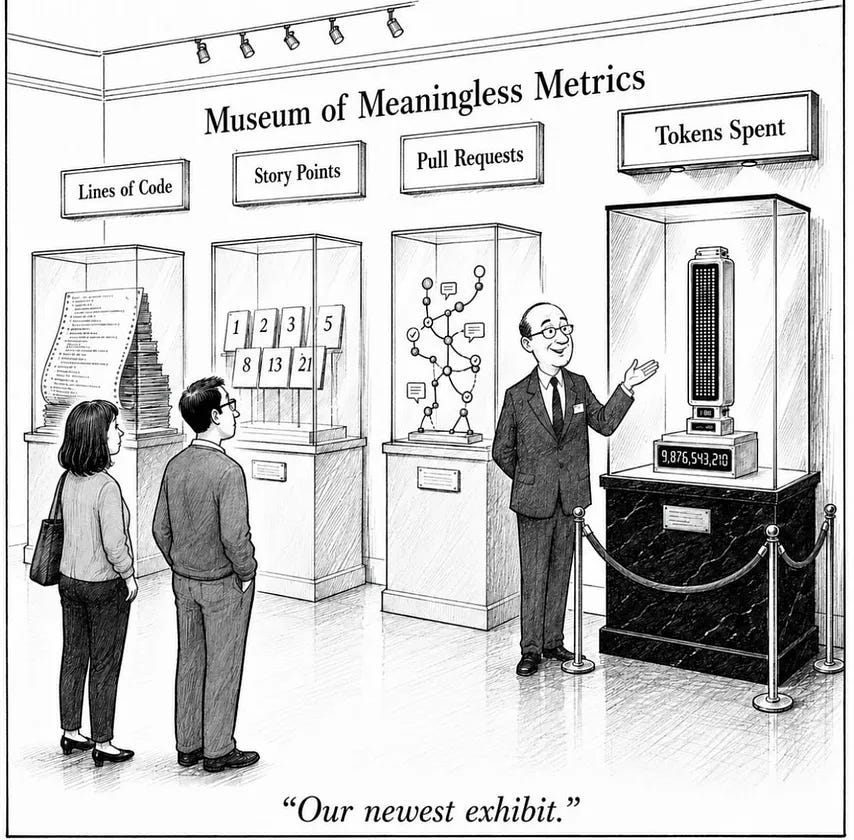
Alberto Romero (@thealgorithmicbridge): "Museum of Meaningless Metrics"
End Notes
If you found this useful, you can always buy me a coffee.
If you need consulting help navigating any of this, find me at Maverick.